
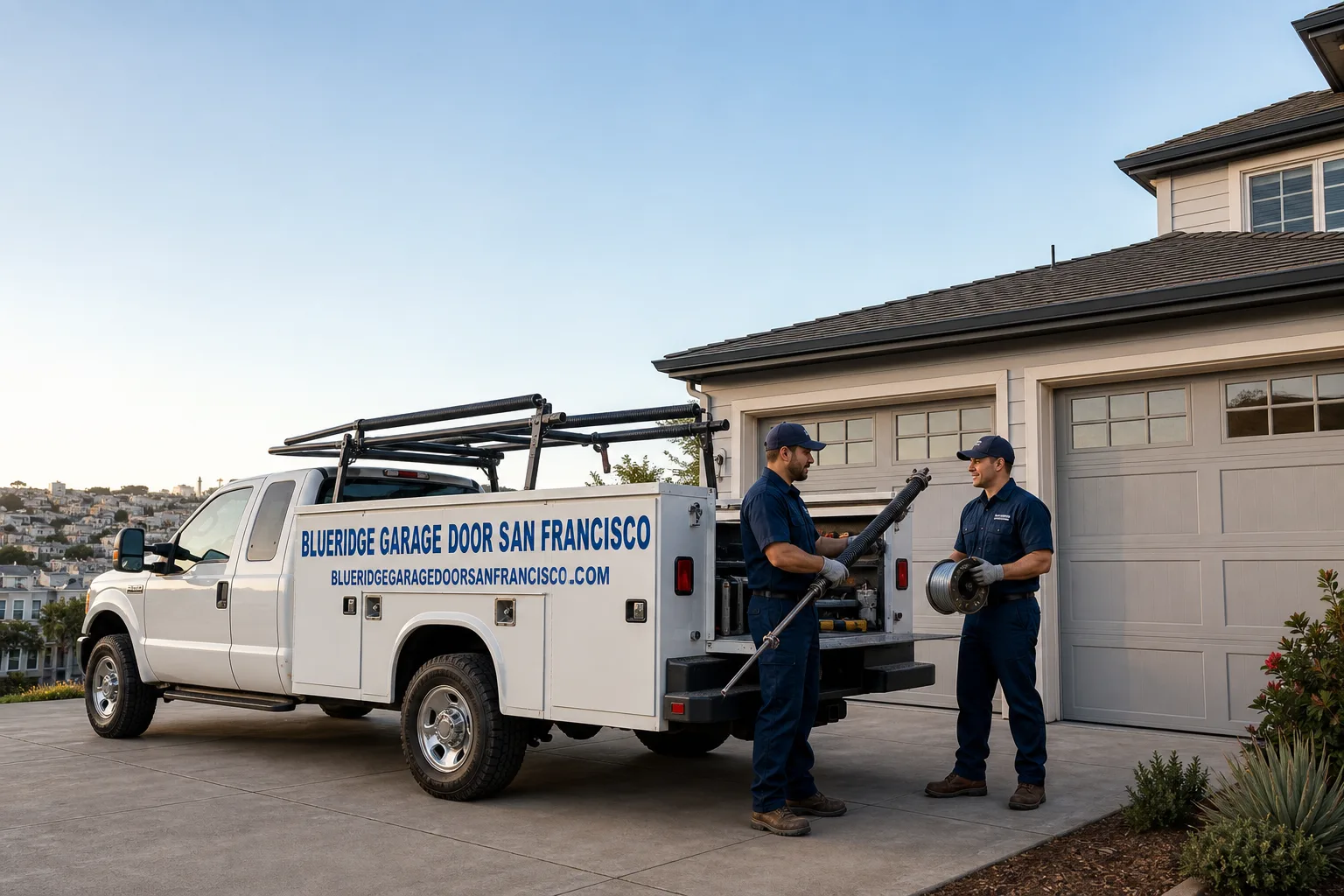
Trusted Garage Door Parts for San Francisco Homeowners
Garage door parts replacement in San Francisco typically costs $130–$400 depending on the component, and most jobs are completed same day. At Blueridge Garage Door, we’ve spent 12 years sourcing, diagnosing, and installing the exact parts that keep San Francisco doors running through salt air, hillside moisture, and daily wear. Call us at (833) 392-0116 for a free estimate.
We’ve seen it, we’ve fixed it. From torsion springs snapping in Noe Valley Victorians to rollers grinding to a halt in Visitacion Valley townhomes, our founder and Master Technician Brian Whitfield has handled every parts scenario this city throws at us. Our 251 verified reviews averaging 4.7 stars aren’t from luck. They’re from showing up with the right part, the right tool, and the know-how to install it without callbacks. San Francisco’s garage doors face unique stress — steep driveways that angle tracks, fog-driven corrosion on hardware, and century-old framing that doesn’t always match modern specs. Generic parts from a big-box shelf often fail within months here. We stock and source components rated for this environment, and we match them to your specific door rather than forcing a one-size-fits-all fix.
What Our Garage Door Parts Service Includes
Torsion Spring
Torsion springs are the heavy-duty coils mounted above your door that store mechanical energy to lift hundreds of pounds smoothly. In San Francisco, we regularly see premature torsion spring failure in homes near the Pacific — the salt air accelerates corrosion on the spring surface, leading to stress fractures that snap without warning. Brian and his team measure your door’s weight, track radius, and drum size to spec the exact wire gauge and length; a mismatched torsion spring will either fail early or damage your opener.

Extension Spring
Extension springs stretch along the horizontal tracks on either side of your door, providing lift through tension rather than torque. They’re common on older San Francisco homes with limited headroom above the opening, particularly in neighborhoods like Chinatown where building footprints are tight and ceiling heights are low. We replace extension springs in matched pairs to maintain balanced lift, and we always install safety cables through the center of each spring to contain the coil if it breaks.

Cables & Drums
Lift cables wrap around drums at the end of your torsion tube, translating spring energy into vertical door movement. Frayed cables are a genuine hazard — under full tension, a snapping cable can cause serious injury or property damage. We inspect drum wear patterns closely; uneven winding indicates a door that’s out of balance or tracks that are misaligned. For San Francisco’s hillside homes with non-standard ceiling heights, we often source high-lift or vertical-lift drum configurations that aren’t stocked by standard suppliers.

Rollers & Hinges
Rollers guide your door through the track curves, while hinges flex thousands of times per year as sections articulate. Nylon rollers with sealed bearings outlast steel rollers in our climate, and we keep multiple stem lengths on hand for the varied track geometries we encounter across the city. Hinge failure usually shows first as a popping sound during operation; left unaddressed, the door panel can separate from the track entirely. We match hinge gauges to door weight — a 14-gauge hinge on a heavy wood door will fatigue and crack.

Weatherstripping
Bottom and perimeter weatherstripping seals the gap between your door and the frame, blocking wind, rain, and the fine particulate that blows through San Francisco’s summer gaps. We use vinyl or rubber compounds rated for UV exposure and temperature cycling; cheap foam strips degrade to dust within a single season here. For homes in the Sunset or Richmond facing direct Pacific exposure, we often recommend brush-style seals with integrated drip caps that shed wind-driven rain more effectively than standard bulb seals.

Bottom Seal
The bottom seal is your door’s first defense against water intrusion, pests, and debris — and it’s the component we replace most frequently in this city. Garage floors in older San Francisco homes often slope toward the door or settle unevenly, creating gaps that standard seals can’t bridge. We carry bulb, bead, and T-style profiles in multiple widths, and we’ll shape the seal to follow your floor contour rather than leaving you with a channel that funnels water inside.

What happens when you call
- 1
A real person answersNo phone trees — you reach a local pro.
- 2
You get an upfront price rangeHonest numbers before anyone is dispatched.
- 3
A background-checked tech heads outLicensed & insured, dispatched right away.
- 4
You approve before work beginsNothing starts until you say go.
Brands We Service for Garage Door Parts
Your brand, our expertise. We’ve serviced hundreds of Amarr steel and insulated doors across San Francisco, from the carriage-house designs popular in Noe Valley to the commercial-duty models installed in Mission District live-work spaces. We stock Amarr-compatible hinges, rollers, and bottom fixtures, and we know the specific spring conversions needed when homeowners upgrade from a non-insulated to an insulated Amarr panel.
Wayne Dalton doors present unique parts challenges — their TorqueMaster spring system and proprietary hinge designs aren’t interchangeable with standard hardware. We’ve rebuilt dozens of these units in San Francisco, sourcing factory-correct components rather than forcing generic substitutes that void remaining warranty coverage. Craftsman openers and door systems remain common in the city’s 1990s-era construction; we keep drive gears, limit switches, and safety sensor pairs in stock for same-day resolution. And for Raynor doors — particularly the commercial operators found in SOMA and Dogpatch warehouses — we source OEM cables, drums, and spring assemblies through authorized channels. Whether you have Raynor or any other make, we can help.
Signs You Need Garage Door Parts Right Now
- A loud bang from the garage, followed by a door that won’t lift. This is the classic torsion spring failure signature. The stored energy releases instantly, and your opener motor is now trying to lift dead weight it was never designed to handle. Running the opener in this condition strips gears and burns out the drive system, turning a $210–$400 spring job into a repair that approaches opener replacement cost.
- The door hangs crooked or one side rises faster than the other. Uneven lift points to a failed extension spring, a frayed cable, or a drum that’s slipped on the torsion tube. In San Francisco’s older homes with settling foundations, this symptom can also indicate track misalignment compounding a parts failure. Either way, continued operation risks derailment or panel damage.
- Grinding, squealing, or rhythmic clicking during door travel. Metal-on-metal grinding usually means roller bearing failure; clicking often indicates a cracked hinge flexing beyond its limit. These sounds are your door’s warning system — the component is degrading in real time, and catastrophic failure typically follows within days or weeks of the first noise.
- Visible gaps of light or draft around the closed door perimeter. Weatherstripping and bottom seal deterioration happens gradually enough that homeowners adapt without noticing. But in San Francisco’s wet season, that gap channels water directly onto your garage floor and anything stored there. It also provides rodent access — a significant concern in neighborhoods bordering parkland or green corridors.
- The opener runs but the door barely moves or reverses immediately. This often indicates a spring system that’s lost tension, forcing the opener to hit its force limit and trigger safety reversal. Homeowners sometimes misdiagnose this as an opener problem and replace a fully functional motor. We test spring balance first on every service call to avoid this expensive error.
Our Garage Door Parts Process — Step by Step
- 1
Call and describe what you’re seeing. We’ll ask about sounds, symptoms, and your door’s age and brand. This helps Brian or a senior technician arrive with the most likely parts already on the truck, cutting diagnostic time and getting your door functional faster.
- 2
On-site inspection and safety check. We start every visit by securing the door in the closed position and releasing tension from the spring system using proper winding bars. We inspect all moving components — not just the obviously failed part — because one stressed component often indicates others near failure. In San Francisco’s corrosive coastal climate, we pay particular attention to cable rust and hinge corrosion that might not yet be causing symptoms.
- 3
Exact measurement and parts specification. For springs, we measure wire gauge to the thousandth of an inch, inside diameter, and overall length. For rollers, we confirm stem diameter and wheel diameter against your track profile. We don’t guess. A torsion spring that’s half an inch too long or one wire size off will either underperform or overstress your hardware.
- 4
Installation with calibrated tools. Spring winding requires precise tension calculation based on door weight; we use a digital scale and standard torsion spring formulas, not rules of thumb. For cable and drum work, we level the door in the opening and verify equal lift height on both sides before declaring the job complete.
- 5
Full-cycle testing and homeowner walkthrough. We run the door through a minimum of ten complete open-close cycles, listening for irregular sounds and watching for smooth travel. We show you what was replaced, why it failed, and what maintenance will extend the life of adjacent components. Then we leave the workspace cleaner than we found it.
How Much Does Garage Door Parts Cost in San Francisco?
A typical roller replacement in San Francisco runs $130–$260 depending on how many rollers need swapping and whether we’re converting from steel to sealed-bearing nylon. Cable repair ranges from $155–$295, with the upper end covering paired replacement on heavier wood doors or doors with non-standard drum configurations. Spring work — the most common parts call we receive — falls between $210–$400 for torsion systems and slightly less for extension spring pairs on lighter doors.
Several factors push costs toward the higher end of these ranges. San Francisco’s hillside homes often require custom spring lengths or high-lift track hardware that isn’t stocked by standard suppliers. Older doors in neighborhoods like the Mission District or Chinatown may have obsolete hinge patterns or roller stem sizes that we need to source through specialty channels. And when multiple components fail simultaneously — common after a spring snaps and the door crashes off-track — the repair compounds across parts categories.
You avoid overpaying by getting a written, itemized estimate before any work begins. Our free estimates include full parts breakdown with individual line items, not a single opaque total. We don’t charge diagnostic fees that get waived only if you approve the repair — our inspection and estimate are genuinely no-obligation. Call (833) 392-0116 for exact pricing on your specific door.
| Service | Typical Range in San Francisco |
|---|---|
| Roller Replacement | $130 – $260 |
| Cable Repair | $155 – $295 |
| Spring Repair | $210 – $400 |
Garage Door Parts Near San Francisco — Our Service Area
We maintain full parts inventory for same-day service throughout San Francisco proper, from the Marina to the Excelsior, and we regularly run calls to Winters and the broader Bay Area. Typical response time in the city is within hours for standard requests, and our Garage Door Parts in Mission District coverage means we know the specific building stock and access challenges of that neighborhood. We also serve Garage Door Parts in San Francisco homeowners in Chinatown, Noe Valley, Visitacion Valley, and surrounding communities. Whether you’re in a Victorian flat with a converted carriage entrance or a modern SOMA podium garage, we’ve worked on your door type before.
Serving San Francisco, CA — Our Local Coverage Area
We’re based in the San Francisco area and know this community well. Use the map below to see our service coverage — if you’re nearby, we can almost certainly help.
Frequently Asked Questions — Garage Door Parts in San Francisco
Garage door parts service is the professional replacement of worn or failed hardware components — springs, cables, rollers, hinges, and seals — that allow your door to open, close, and seal properly. At Blueridge Garage Door, we don’t just swap the broken piece; we inspect the full system to identify components that are stressed and likely to fail next, preventing repeat service calls.
Most single-component replacements — a spring, a cable set, or a batch of rollers — take 45 minutes to 90 minutes on site. Multi-component repairs or doors with access limitations (tight garages, stacked storage, or rooftop parking structures common in San Francisco) can extend to two hours. We quote time expectations with our estimate so you can plan your day.
Typical garage door parts service in San Francisco ranges from $130 for roller replacement to $400 for complex spring work on heavy or custom doors. The final price depends on component type, door weight, and whether multiple parts need simultaneous replacement. Call (833) 392-0116 for an exact quote — estimates are free.
Yes, we service Craftsman systems and stock common failure parts including drive gears, circuit boards, and safety sensors. Craftsman openers share architecture with Chamberlain and LiftMaster products, and our 12 years of experience across all eight major brands means we diagnose these units efficiently rather than treating them as unfamiliar equipment.
Yes, emergency garage door service is a dedicated offering at Blueridge Garage Door, not an afterthought. A failed spring or snapped cable leaves your door inoperable and your home exposed — we prioritize these calls and maintain after-hours parts inventory to restore security when you need it most. Call (833) 392-0116 anytime.
We warranty both our labor and the parts we install. Spring warranties vary by component grade — standard springs carry shorter coverage, while cycle-rated springs for high-use doors carry extended terms. We document your warranty in writing at completion, and because we’re a founder-run business, you call Brian directly if any issue arises rather than navigating a corporate claims line.
Clear a path to your garage door and move vehicles out of the garage if possible — we’ll need floor space to lay out tools and stage the door if we release it from the opener. Note any recent sounds or behavior changes; this history helps us diagnose faster. There’s no need to attempt any disassembly yourself, and we strongly advise against touching spring hardware — the tension is genuinely dangerous without proper tools and training.
Schedule Your Garage Door Parts Service in San Francisco Today
Don’t let a grinding roller or a frayed cable turn into a door off-track or an opener burned out from overload. Brian and his team are ready with the right parts, the right tools, and 12 years of San Francisco-specific experience to fix it right the first time. Call (833) 392-0116 now for your free, no-obligation estimate — we’re available same day and for emergency response when your door fails at the worst possible moment.
Written by Brian Whitfield, Owner at Blueridge Garage Door, serving San Francisco since 2012.