
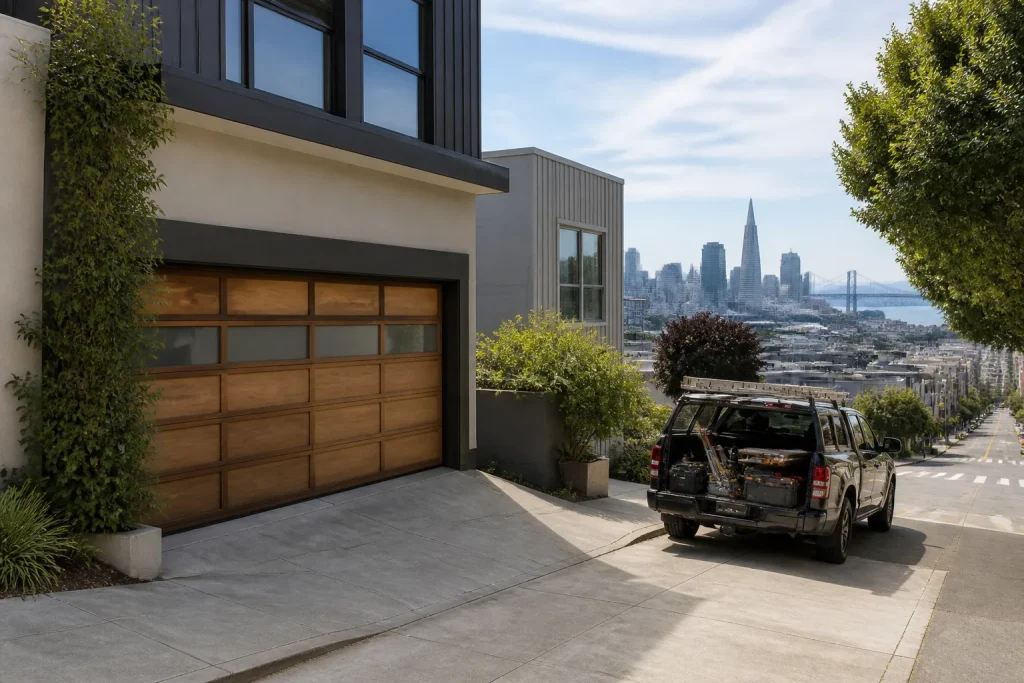
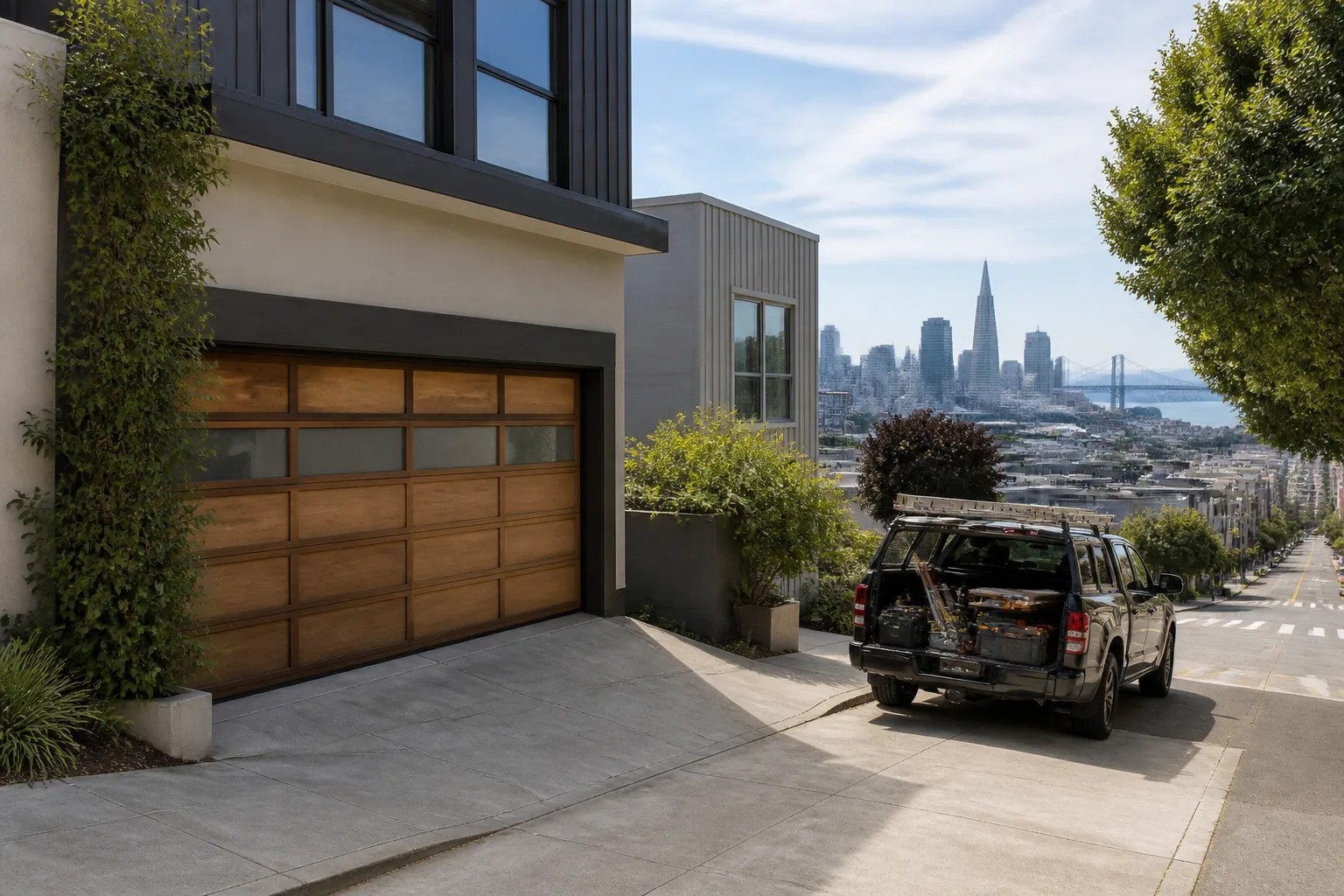
Garage Door Repair: Repair or Replace? How San Francisco Homeowners Decide
Most San Francisco homeowners should repair their garage door when the fix costs less than half of replacement and the hardware stack — springs, cables, opener, and panels together — has more than 3 years of reliable life left. Replace when multiple major components are failing within a 2-year window, or when structural damage compromises the door’s safety. If you’d rather not sort this out alone, call us at (833) 392-0116 for a free, no-pressure estimate.
Replacing a single cracked panel on a 15-year-old door is like putting new tires on a car with a failing transmission — you’ve spent money without solving the problem that’s actually coming for you next. We’ve seen this exact scenario in garages from the Sunset District to Bernal Heights: a homeowner pays $400 for a panel swap, then the spring snaps six months later, then the opener dies the following year. Three repairs, three service calls, and they’ve outspent a new door installation without the benefit of one. The repair-or-replace decision isn’t about today’s broken part. It’s about reading the whole system.
What Is the ‘Hardware Stack Age’ and Why Does It Matter?
Every garage door is a stack of interdependent components, each with its own lifespan. Torsion springs typically last 10,000 cycles (roughly 7–10 years for average use). Cables fray and weaken around the same window. Openers from quality brands like LiftMaster or Chamberlain often run 10–15 years if maintained. Panels can last decades cosmetically but lose structural integrity from bottom-rail rust or impact damage.
The critical concept we teach San Francisco homeowners is stack convergence: when multiple components hit end-of-life simultaneously, repair becomes a money pit. Here’s how to read your stack:
- Green light: One component failed, everything else tests strong — repair makes sense
- Yellow light: Two components showing wear, door is 12+ years old — evaluate replacement seriously
- Red light: Spring broke, cables are frayed, opener is noisy and slow — replace the system
In neighborhoods like Noe Valley and Pacific Heights, where many homes were built in the 1920s–1950s, we regularly encounter original garage doors that have been patched repeatedly. The wood is sound, the hardware stack was replaced 8 years ago — those doors have good bones. But a door in the Mission with original springs, a 2008 Craftsman opener, and rust-spotted cables? That’s a stack converging toward failure.
The 50% Rule and When to Break It
You’ll hear a common guideline: if repair costs exceed 50% of a new door’s price, replace. That’s useful as a starting point, but it’s not gospel. We’ve broken this rule dozens of times for good reason.
Follow the 50% rule when: the door is 15+ years old, the damage is structural (bent track, cracked bottom section, failing motor), or you’ve already repaired the same component twice.
Ignore the 50% rule when: the door itself is high-quality (solid wood, custom sizing, or a premium brand like Amarr or Wayne Dalton), the hardware stack was recently updated, or the repair addresses isolated damage (vehicle impact, single failed spring on a dual-spring system, stripped gear in an otherwise strong opener).
Last month we repaired a $680 spring and cable job on a 20-year-old Raynor door in Sea Cliff. The homeowner had replaced the opener in 2019. Total stack value was solid, the door panels were straight, and a new equivalent would have run $2,400 with custom sizing. That repair was the right call despite clearing the 50% threshold on a basic steel door.
San Francisco pricing reality: standard 16×7 steel door replacement here runs $1,800–$3,200 depending on insulation, windows, and hardware grade. Repairs typically fall between $180–$850. Use those benchmarks, but test them against your stack’s actual condition, not just the receipt.
San Francisco’s Older Housing Stock: The Hidden Cost of Replacement
Here’s what national repair-or-replace guides never tell you: San Francisco’s housing stock makes replacement significantly more complex than in a Phoenix suburb or a Dallas new-build.
Many garages in this city, particularly in Victorians and Edwardians from the Haight to the Richmond, have non-standard openings. Heights under 7 feet, widths that don’t match modern stock sizes, or header constraints that limit track geometry. A standard 16×7 door slides right in most places. Here, we often measure, fabricate, or modify.
That complexity adds 20–40% to replacement cost compared to national averages. It also means a functional older door, even with some wear, carries extra value simply because it already fits. We’ve had homeowners in the Outer Sunset discover their 6’8″ opening would require structural modification to accept any modern door — a $1,200 add-on before the door itself.
This is why we always measure twice and ask about the home’s construction era before recommending replacement. Sometimes the math that says “replace” in Sacramento says “repair and maintain” in San Francisco.
Cosmetic vs. Structural Damage: What Actually Matters
Homeowners often panic over panel dents and scuffs that are purely cosmetic. Meanwhile, they ignore bottom-section rot or track misalignment that creates real safety hazards. Here’s how we separate the two:
Almost always repairable: surface dents in steel panels, faded paint, minor window seal failure, cosmetic hardware tarnishing, isolated panel scratches. These affect curb appeal, not function. For street-facing doors in neighborhoods like St. Francis Wood or Presidio Heights, we get why appearance matters — but it’s a paint job or panel-skin issue, not a replacement trigger.
Usually tips toward replacement: bottom section water damage or rust (compromises the door’s structural rail), cracked or delaminated panels that affect hinge attachment points, bent or twisted track sections, opener mounting bracket failure where the header itself is damaged. These problems propagate. Water wicks upward, misalignment stresses springs and cables, and a door that can’t hold its hardware safely is a door that needs replacing.
We pulled a door out of a garage in the Excelsior last year where the bottom section looked fine until we lifted it. The interior rail had rusted through completely — the panel was being held by paint and optimism. That’s structural. That’s replacement.
Insulation, Noise, and Curb Appeal: The SF-Specific Factors
Three quality-of-life factors shift the repair-replace math for San Francisco homeowners more than most guides acknowledge.
Insulation value: Many SF homes have attached garages sharing walls with living spaces. An uninsulated steel door in a Sunset District home means that garage is a thermal bridge into your kitchen or bedroom. If you’re repairing an old non-insulated door, you’re locking in that energy loss for another decade. Modern doors with R-values of 12–18 make a noticeable difference in heating costs and comfort. For attached garages, we often suggest weighing replacement more heavily.
Noise: Belt-drive openers and nylon rollers have transformed how quietly a garage door can operate. If your bedroom sits above or beside the garage — common in SF’s vertical layouts — a noisy chain-drive system isn’t just annoying, it’s daily disruption. Repairing the door while keeping the clattering opener is solving half a problem.
Curb appeal: In this market, your garage door can represent 20–30% of your home’s street-facing facade. A dented, mismatched, or obviously dated door hurts first impressions. We’ve had homeowners in Pacific Heights replace purely for aesthetics before listing, and the investment consistently returns. That said, if you’re staying put and the door functions well, a $300 respray and hardware refresh often achieves 80% of the visual upgrade.
When to call a pro: If you’re unsure about your hardware stack’s condition, don’t guess. A trained technician can test spring tension, cable integrity, opener force settings, and panel structural soundness in 15 minutes. Garage Door Repair in San Francisco from Blueridge Garage Door includes this full-system evaluation with every service call.
When Emergency Repair Becomes the Right Call
Sometimes the decision isn’t philosophical — it’s 10 PM and your door won’t close. A stuck-open garage in San Francisco isn’t just inconvenient; it’s a security exposure in a dense urban environment.
Our Blueridge Garage Door San Francisco home page outlines our emergency response, and we treat these calls seriously. But even in urgency, the stack matters. If we arrive and find a single failed spring on a door with 3 years of solid hardware ahead, we repair. If we find a door held together by previous patch jobs, we’ll show you exactly what we see and give you real options — including temporary secure-close if replacement makes more sense in daylight with a clear head.
We’ve been doing this for 12 years, and our 251 reviews reflect one consistent theme: homeowners want honesty about what’s worth fixing and what isn’t. That’s what we deliver, whether it’s Tuesday afternoon or Saturday midnight.
Related services in San Francisco: For doors that have reached end-of-life, our Garage Door Installation in San Francisco covers custom-fit replacement for non-standard openings. For opener-specific concerns, see Garage Door Opener in San Francisco.
The Bottom Line
The repair-or-replace decision comes down to three questions: What’s actually broken? What’s likely to break next? And what does this specific door in this specific San Francisco home require?
Key takeaways:
- Evaluate the full hardware stack, not just today’s symptom
- Use the 50% rule as a guide, not a mandate — quality doors with good bones deserve repair
- Factor in San Francisco’s non-standard openings and higher replacement complexity
- Structural damage (bottom section, track, mounting) pushes toward replacement; cosmetic damage rarely does
- Attached garages and street-facing doors shift the math toward insulation, noise, and curb appeal benefits
If you’re in San Francisco and staring at a door that isn’t working right, you don’t need to sort this out alone. Call Blueridge Garage Door at (833) 392-0116 for a free estimate. We’ll evaluate your full hardware stack, explain what we see, and give you straight answers on whether repair or replacement makes sense for your situation. No pressure, no upsell — just 12 years of experience applied to your door.
Frequently Asked Questions
Most repairs in San Francisco range from $180 to $850 depending on the component — spring replacements typically run $250–$450, cable jobs $180–$320, and opener repairs $200–$500. Full replacement starts around $1,800 for basic steel and can exceed $3,200 for insulated or custom-fit doors in older homes with non-standard openings. Call (833) 392-0116 for an exact quote on your specific door — estimates are free.
Most dented steel panels can be repaired or replaced individually without replacing the entire door. We use panel-skin replacement or paintless dent techniques for minor damage. Replacement becomes necessary when the dent affects hinge attachment points, compromises the panel’s structural rail, or when matching panels are no longer manufactured for older doors. We’ve saved San Francisco homeowners thousands by repairing single panels that other companies insisted on replacing entirely.
A quality garage door in San Francisco’s moderate coastal climate should last 20–30 years for the door itself, though the hardware stack (springs, cables, opener) typically needs attention every 7–12 years. The salt air in neighborhoods closer to the Pacific — the Sunset, Richmond, and Marina — can accelerate bottom-section corrosion compared to inland areas. Regular lubrication and inspection every 2 years extends lifespan significantly in this environment.
Opener repair makes sense when the unit is under 10 years old and the failure is isolated — stripped gears, faulty safety sensors, or circuit board issues on otherwise strong motors. Replacement is smarter when the opener predates 2015 (missing modern safety features), the motor is failing, or repair costs exceed $350 on a basic chain-drive unit. For attached garages in San Francisco, we often recommend upgrading to a belt-drive opener for noise reduction alone — the daily quality-of-life improvement is substantial. Call (833) 392-0116 and we’ll test your opener’s force settings, motor draw, and safety reverse to give you a straight recommendation.
Written by Brian Whitfield, Founder & Master Technician at Blueridge Garage Door San Francisco, serving San Francisco since 2014.
Need Garage Door Help?
Call Blueridge Garage Door San Francisco — licensed & insured, here with fast after-hours help in San Francisco.
(833) 392-0116