
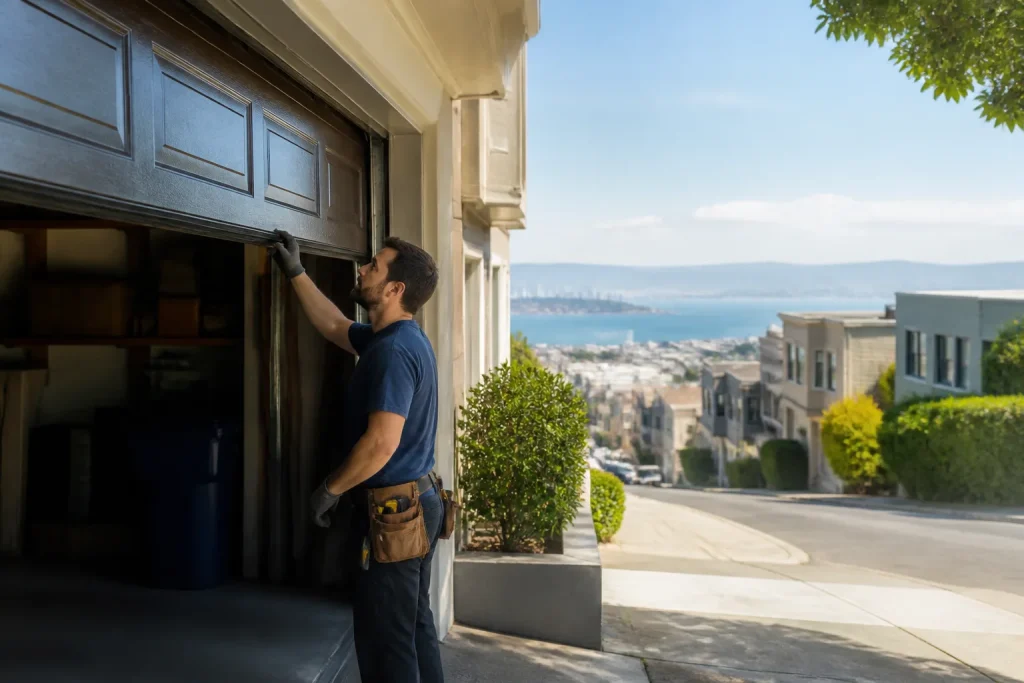
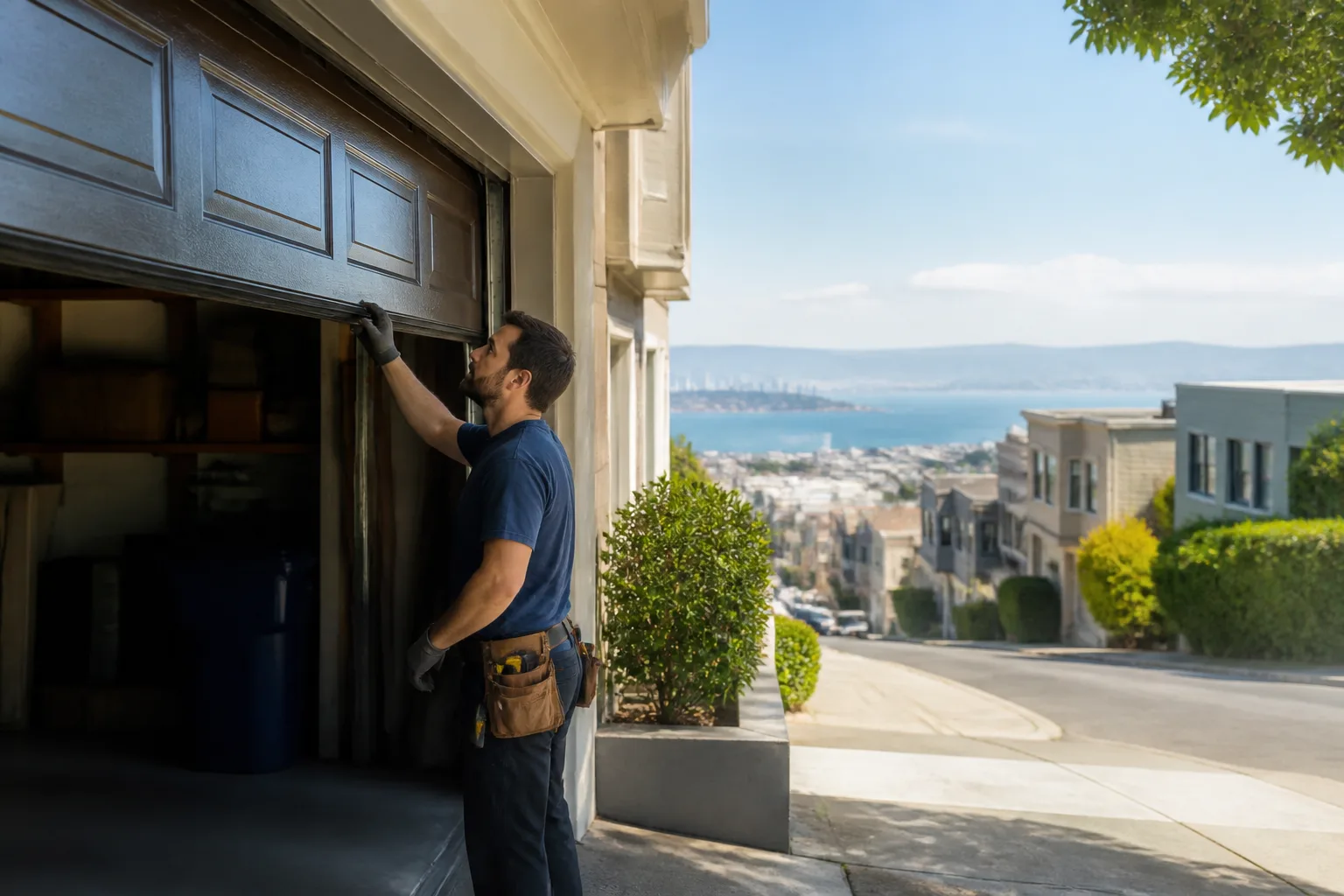
Emergency Garage Door Repair Near Me: What San Francisco Homeowners Should Do First
When your garage door fails and won’t secure your home, first check if the door is stuck open or closed, pull the emergency release cord only if the door is fully closed, manually lock the door if it’s open, then call a local technician with your opener model and symptom details. In San Francisco, where a garage left open overnight invites real trouble, those first 20 minutes matter more than most homeowners realize. If you’d rather not handle any of this yourself, call Blueridge Garage Door at (833) 392-0116 — we’re here when you need it most.
Last Tuesday at 9:47 PM, a homeowner in the Outer Sunset called us in a panic. Their Craftsman opener had quit mid-cycle, leaving the door gaping open onto 40th Avenue. By the time we arrived, they’d already tried forcing the door down by hand and bent two bottom rollers. The original problem was a $180 sensor alignment. The new problem was a $340 track and roller repair. Those first 20 minutes cost them an extra hour and $160.
We’ve seen it, we’ve fixed it — and after 12 years and 251 reviews in this city, we can tell you exactly where homeowners go wrong.
How to Secure a Garage Door That Won’t Close
A garage door stuck open in San Francisco isn’t a tomorrow problem. It’s a tonight problem. Property crime rates in this city mean an unsecured garage is an active invitation, not a passive risk.
Here’s what to do in the right order:
- Don’t pull the emergency release cord if the door is open. That red handle disengages the opener carriage, and on an open door with a broken spring or cable, gravity takes over immediately. The door can slam down with enough force to damage itself or injure anyone nearby.
- If the door is fully closed and won’t open, pulling the release cord is safe. The door should stay put on its springs. You can then lift it manually if the springs are intact — but if it feels heavy or lopsided, stop. The spring system is compromised, and a 200-pound door dropping unevenly will destroy the track.
- For an open door that won’t close: Check the photo-eye sensors first. In San Francisco’s fog belt neighborhoods like the Sunset and Richmond, condensation on sensor lenses is common. Wipe them with a dry cloth and realign if they’re bumped askew.
- Manual lock from inside: Most sectional doors have a slide bolt or latch on the inside center stile. Engage it. If your door lacks one, a C-clamp on the track above a roller is a field-expedient lock that will slow down anyone trying to lift the door from outside.
We pulled one out of a garage over in the Mission last month where the homeowner had threaded a bike lock through the track holes. Creative, but it worked until morning.
The Safe Way to Disconnect a Broken Spring Door
This is where people get hurt. Torsion springs store massive mechanical energy — enough to counterbalance 150 to 400 pounds of door weight. When one breaks, the door becomes dead weight on one side.
Most homeowners make two critical errors:
- They try to operate the opener anyway, burning out the motor or stripping the nylon gear
- They pull the emergency release on an open door, thinking they’ll “just lower it gently”
The second one is especially dangerous. Without spring tension, a wooden or insulated steel door can free-fall. We’ve replaced openers in Noe Valley where the homeowner heard the spring snap, thought the door felt “manageable,” and ended up with a bent top section and a stripped LiftMaster trolley.
If you hear a loud bang from the garage and the door suddenly feels heavy or crooked, the spring broke. Leave it alone. Unplug the opener to prevent anyone from accidentally hitting the button. If the door is closed, it will stay closed without spring tension — don’t touch it. If it’s open, clear the area underneath and call for same-day service.
Our Garage Door Repair in San Francisco page covers spring replacement in detail, but the short version is: this repair requires winding bars, specific knowledge of door weight, and respect for the stored energy in a new spring. Brian and his team handle this daily. You shouldn’t.
What to Tell the Technician Before They Arrive
The information you gather in those first 20 minutes determines whether we show up with the right springs, the right opener gear kit, or the right logic board. Wrong information means a second trip, and in San Francisco traffic, that second trip might not happen until tomorrow.
Here’s what cuts our diagnostic time in half:
- Opener model number: Usually on a sticker near the light lens or on the motor housing side. “LiftMaster 8550W” tells us more than “it’s a LiftMaster.”
- Door manufacturer and approximate age: Clopay, Amarr, Wayne Dalton — each uses different hardware standards. A 15-year-old Raynor may have discontinued hinge styles we need to source before arriving.
- Exact symptom and sequence: “Door started shaking mid-cycle, then the opener clicked but didn’t move” points to a stripped drive gear. “Door went up fine, won’t come down, lights don’t blink” suggests a circuit board relay failure.
- Whether the failure was sudden or progressive: A door that got louder over two weeks before quitting usually has worn rollers or a failing bearing. Sudden failure with a loud noise is almost always a spring or cable.
- Any recent work: If another company adjusted the springs last month, we need to know. Improper spring tension can mask as an opener problem.
In our experience, homeowners who can answer these four questions get same-day fixes. Those who can’t sometimes wait an extra day for parts.
How to Spot a Real Local Technician vs. a Dispatch Center
Search “emergency garage door repair San Francisco” at 10 PM and you’ll see ads promising 24/7 response. Some are real. Many are national lead-generation operations that sell your call to the lowest-bidding subcontractor who happens to be awake.
Here’s how to tell in 60 seconds:
- Ask who owns the company. A real local shop names a person. “Brian Whitfield at Blueridge Garage Door” — that’s verifiable. “We’re a nationwide network of certified technicians” means your job is being auctioned.
- Ask if they stock parts for your brand. If you have a Chamberlain or Genie opener, a legitimate San Francisco technician knows whether they carry common failure parts for those models. A call-center rep reads from a script.
- Ask for an arrival window, not a guarantee. Anyone promising “30 minutes or less” in San Francisco during rush hour or Giants game traffic is lying. Realistic windows — “between 8 and 10 AM” or “within 2 hours” — indicate actual route planning.
- Check review volume and recency. 251 reviews averaging 4.7 stars over 12 years is a track record. Three reviews from 2019 is not.
Your brand, our expertise — that’s not a slogan, it’s how we operate. When you call Blueridge Garage Door, you speak to someone who knows whether your specific Craftsman model uses a chain drive or belt drive, and whether the common failure is the capacitor or the RPM sensor.
San Francisco-Specific Factors That Affect Emergency Response
Not every emergency repair in San Francisco can be finished same-day, even with the right technician. Geography and building stock create real constraints.
Neighborhood access: Twin Peaks, Nob Hill, and parts of Pacific Heights have steep, narrow garages where standard service vehicles can’t maneuver. We plan for this, but it adds transit time. SOMA and the Mission have easier access but worse parking — our techs carry equipment for a 2-block walk when necessary.
Door age and type: San Francisco’s housing stock includes Victorian carriage houses with custom wood doors, 1960s Eichler-style homes with unusual opening heights, and modern condos with glass-paneled aluminum doors. A custom Clopay wood door from 1987 may need hardware we can’t source until morning. We stock common parts for standard steel sectional doors, but specialty orders require a next-day return trip.
Time and tide: Friday 6 PM to Sunday noon is our highest-call-volume window. We staff for it, but “same day” in the Richmond District at 8 PM Saturday might mean 10 AM Sunday for a parts-intensive job. We tell you this upfront — anyone who promises otherwise is setting you up for a no-show.
Our Garage Door Installation in San Francisco page covers full door replacement when repairs aren’t economical. For emergency situations, we always present both options with real numbers.
When to Call a Pro vs. What You Can Handle
You can safely handle: sensor cleaning, remote battery replacement, lubricating the hinge points with silicone spray, and engaging the manual lock.
You should call for: any spring or cable issue, any door that feels heavy or uneven, any opener that hums but doesn’t move, any door that’s come off its track, and any situation where the door is stuck open overnight.
Related services in San Francisco: if your opener is the problem, not the door itself, see our Garage Door Opener in San Francisco page for repair and replacement options.
The Bottom Line
The 20 minutes after a garage door emergency are decision-heavy but not complicated. Secure the opening if you can do it safely. Don’t force the opener if the door feels wrong. Gather the model information. Then call someone who knows San Francisco’s neighborhoods, its building stock, and your specific opener brand.
Blueridge Garage Door San Francisco has handled emergency calls from the Presidio to Bayview for 12 years. Brian Whitfield, our founder and master technician, still diagnoses the complex cases personally. 12 years, 251 reviews — that’s the track record behind every emergency call we take.
If you’re in San Francisco and need help now, or want to schedule before a small problem becomes an emergency, call (833) 392-0116 for a free estimate.
Frequently Asked Questions
Most same-day repairs in San Francisco run between $180 and $450, depending on whether it’s a sensor realignment, spring replacement, or opener gear repair. We quote upfront after diagnosis, not after the work is done. Call (833) 392-0116 for an exact estimate — estimates are free.
Yes, for most standard steel sectional doors with common opener brands like LiftMaster, Chamberlain, or Craftsman. Custom wood doors or discontinued Raynor hardware may require a parts order and next-day completion. We tell you which category you’re in before we dispatch.
Repair is usually cheaper if the opener is under 10 years old and the failure is a worn gear, capacitor, or logic board — typically $180–$340. Replacement makes more sense when the opener is 15+ years old, has multiple failed components, or lacks modern safety features. We stock replacement units and can install same-day if you choose that route. Call (833) 392-0116 for a free assessment.
Manually lock it from inside using the slide bolt or a C-clamp on the track, remove valuables from the garage, and call for emergency service first thing in the morning. Don’t sleep with an unsecured garage in this city — the risk of opportunistic theft is real, especially in ground-floor garages facing alleys or side streets. Call (833) 392-0116 and we’ll prioritize your call.
Written by Brian Whitfield, Founder & Master Technician at Blueridge Garage Door San Francisco, serving San Francisco since 2014.
Need Garage Door Help?
Call Blueridge Garage Door San Francisco — licensed & insured, here with fast after-hours help in San Francisco.
(833) 392-0116